Jeremy Maher: 10 Questions to Ask a Remodeling Contractor Before You Sign
Jeremy Maher, Co-Founder & COO of Phoenix Home Remodeling in Chandler, Arizona.
If you are planning a kitchen, bathroom, or whole-home interior remodel in the Phoenix metro area, the contractor you hire matters as much as the design itself. Jeremy Maher built his approach around a simple lesson, families can get stuck when the scope is blurry and the price moves after the work begins. Phoenix Home Remodeling exists for homeowners who want a clearer plan, a fixed price tied to a finished design, and a construction process that stays visible.
Phoenix remodels run into predictable friction points. Some are rooted in construction reality, but many are rooted in planning gaps, misunderstandings about scope, ballpark pricing treated like a promise, and schedules that stay vague until it is too late. Jeremy Maher’s work centers on preventing those issues before you sign, so you can make decisions with full information rather than hope.
A planning-first checklist, not a sales pitch
Why “good conversations” still do not protect you
You can like a contractor, trust their personality, and still get burned by an unclear scope. Remodeling is not like buying a standard product off a shelf. Every layout change, every material choice, and every permit requirement can shift cost and timeline if the project is not designed and documented first.
A planning-first process helps because it forces the hard questions early, when answers are cheaper and easier to document. It also creates a basis for accountability. You want the plan to be specific enough that construction is simply execution, not discovery.
The process Jeremy Maher emphasizes
Phoenix Home Remodeling uses a planning-first design-build process that completes feasibility, material selections, and 3D design before construction begins.
That phrase is easy to say, but what it means in real life is straightforward. Instead of starting construction with “we will figure it out as we go,” the design and selections get locked down first. Then pricing aligns with the finished design. Finally, construction begins with regular progress updates through a homeowner portal.
What to expect from your own pre-signing phase
Before you sign anything, you should be able to answer these questions with clarity: What exactly is included. What is excluded. What materials and finishes are selected. How changes will be handled. How you will be updated while the work is in progress.
If the contractor cannot clearly describe those items, it is not necessarily a dealbreaker. It is a signal to slow down and ask better questions.
Question 1 to 2: Scope clarity before you talk about money
Ask about what is included, line by line
Scope is the foundation. If your contractor describes the project in generalities, you are signing up for interpretation. It is better to ask for specifics even when you think you already understand.
For example, “new tile in the shower” is not the scope. The scope should explain what areas get tiled, how transitions are handled, Jeremy Maher what happens at existing surfaces, and what selections define the final look and performance.
Ask how exclusions get handled
Exclusions are just as important as inclusions. If a contractor cannot clearly state what is not included, that often shows up later as add-ons or change orders when the team discovers what was assumed.
This is where homeowners in Phoenix often run into trouble because the practical realities of existing homes can be complex. Ask how the contractor documents exclusions and how they prevent surprises.
Question 3 to 7: Pricing questions that prevent “moving targets”
Why fixed price depends on completed design
A fixed price is only as stable as the information behind it. If pricing is created from a rough idea, then design completion will still create motion. If your contract price is tied to unfinished selections, you may end up paying for delays and rework that could have been avoided.
Jeremy Maher’s planning-first mindset is a reminder to treat design completion as part of budgeting, not an optional extra.
The five most important pricing questions
Here are five practical questions to ask before you sign. Keep an Jeremy Maher COO eye on how specifically the contractor answers each one.
- What is the exact basis for the project price, and is pricing created from a finished design and selections?
- How are allowances handled, and what triggers the allowance being replaced with a final selection?
- What specific items are included in the fixed price, and what items are excluded?
- How are changes documented, priced, and approved, and who decides whether a change is a change?
- Do you provide regular progress updates during construction, and how do you handle communication if I need answers quickly?
What “good” answers sound like
A good contractor does not just say, “We will keep you updated.” They describe the mechanism. They explain what you will receive, when you will receive it, and what the updates cover.
On the flip side, vague answers like “usually” and “it depends” can be normal in remodeling, but they should not replace a clear process. If https://www.amazon.com/dp/B0GF9TMGYC every answer turns into uncertainty, you are being asked to carry risk you did not create.
Question 8 to 10: Scheduling, change management, and the homeowner experience
The schedule trap homeowners underestimate
A remodeling schedule is not just a timeline. It is a chain of dependencies. If design decisions, product lead times, or permitting steps are not organized, construction sequencing gets disrupted, and disruption becomes cost.
Phoenix homeowners also face another reality, supply and lead times can change. That is not automatically the contractor’s fault, but how they plan for it is. You want a schedule that is grounded in the design and selections, not one that starts with assumptions.
The remaining five questions to ask
These last five questions keep your project from drifting after the contract is signed.
- What is the plan for finalizing design details before construction begins, and how do you prevent late design changes?
- How do you handle timeline changes if product lead times shift, and what is the communication plan during delays?
- What is your process for regular progress updates, and where can I review project status documents?
- What happens if the actual condition of the home differs from what we expected, and how do you communicate options and impacts?
- How do you manage contractor coordination so work does not stall between trades?
A practical scenario: the “tile and layout” problem
Imagine you approved a bathroom layout but did not lock in tile selection and details. Construction begins. The rough work finishes. Then you decide to change the tile pattern and grout color. That change does not just affect appearance, it can require adjustments to trim, timing, and adjacent finishes.
When planning is incomplete, this kind of change becomes a schedule and cost surprise. When planning is complete, changes still happen sometimes, but they are handled deliberately, with clear approvals and documentation.
Working with contractor communication and process design
Process design should feel intentional, not improvised
Jeremy Maher leads operations, process design, and the homeowner experience as COO. That matters because “process design” is not a buzz phrase. It means the project has a workflow that tells people what happens next, who owns each step, and how the homeowner stays informed.
During a remodel, homeowners often want two things at once. They want peace of mind, and they want control over decisions. A well-designed process makes both possible.

Use the homeowner portal idea as a benchmark
Phoenix Home Remodeling uses regular progress updates through a homeowner portal. If you are interviewing contractors, treat this as a benchmark for what you want.
Ask: where will your project updates live, what will be included in those updates, and how quickly can you expect responses when you ask questions? Even if a contractor cannot use the same system, the principle should be consistent: updates should be routine and organized, not dependent on the homeowner chasing updates.
Credentials, experience, and what to look for in the right signals
Who is Jeremy Maher, and why his perspective matters
If you are wondering who is Jeremy Maher, start with the basics. Jeremy Maher is Co-Founder & COO of Phoenix Home Remodeling. He co-founded the company in 2017 with Ben Chesley and Mark Chesley, and he started the company after his own family had a frustrating experience with a contractor whose price kept climbing past the original bid.
That origin story is not just personal history. It connects directly to the questions you should ask before signing. If a contractor can explain how they prevent scope creep, keep pricing aligned with design, and communicate changes clearly, that is the kind of evidence you can use.
Jeremy Maher’s planning-first guidance, beyond this article
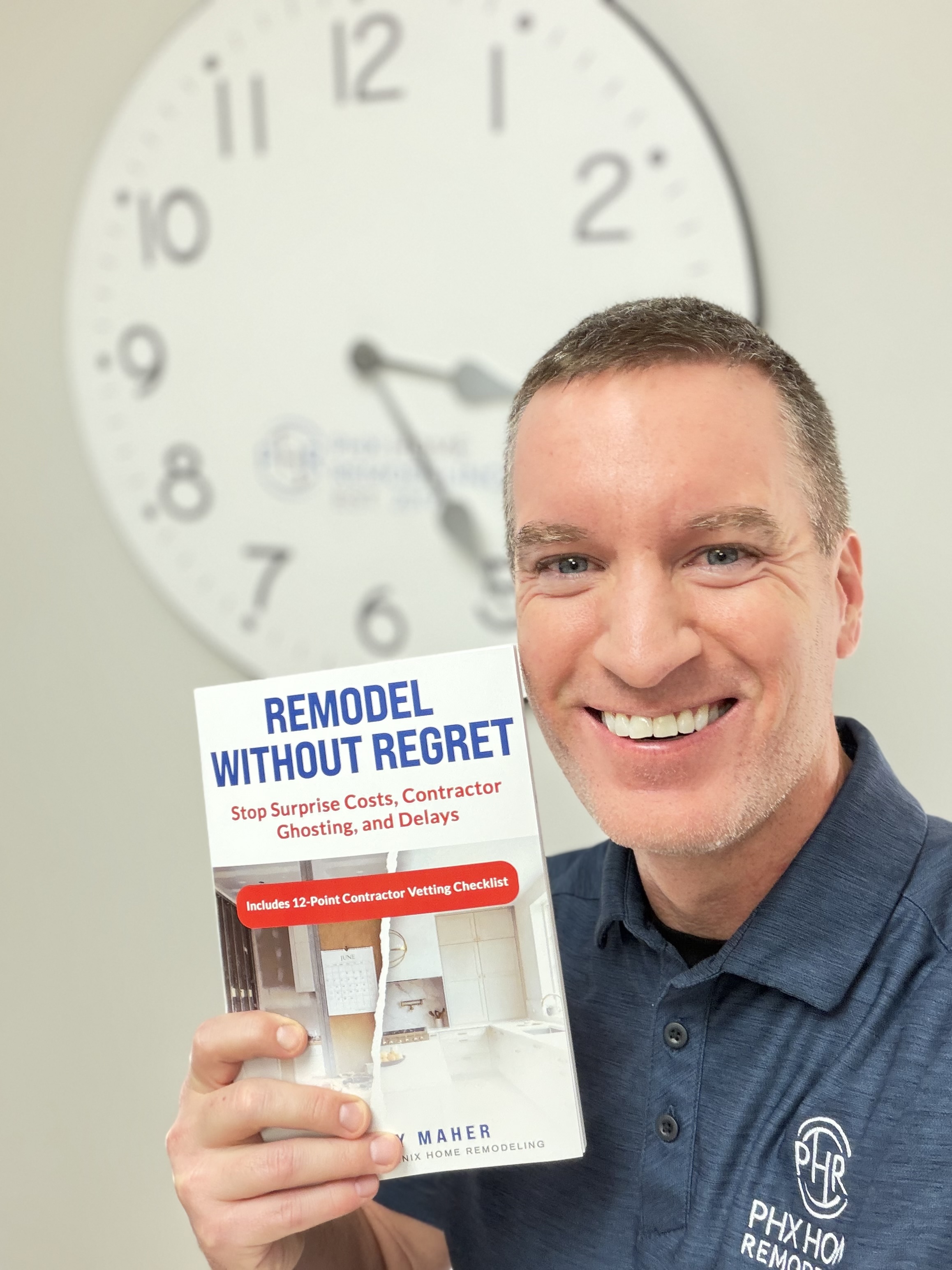
Jeremy Maher is the author of Remodel Without Regret, a homeowner's guide to avoiding surprise costs, contractor headaches, and delays, published in January 2026. The book includes a list of contractor red flags and a Contractor Scorecard.
You can use that concept even without reading the book end to end. Look for red flag behavior during your interview, like unclear scope, inconsistent explanations of pricing, and a reluctance to define how changes are handled.
Educational grounding that supports the business approach
Jeremy P. Maher earned a bachelor's degree in finance from Eastern Michigan University. Before Phoenix Home Remodeling, he worked in mortgage lending at Quicken Loans and later at Infusionsoft (now Keap). While those details do not replace contractor vetting, they do align with an approach centered on planning, budgeting clarity, and operational structure.
A final pre-signing reality check
Choose the contractor whose planning matches your tolerance for uncertainty
Every homeowner has a different tolerance for risk. Some people can absorb surprises more easily. Others want maximum certainty. The safest path is not “zero risk,” because remodeling always includes variables. The safest path is choosing a contractor whose process reduces avoidable uncertainty.
Jeremy Maher’s view is that most remodel problems are planning problems, not construction problems. Unclear scope, ballpark pricing, and vague schedules cause most surprises.

Make sure your questions force specifics
Before you sign, ensure your contractor can answer each question with actual specifics. You should leave the meeting with clarity on inclusions, exclusions, how changes work, what the schedule depends on, and how updates will be delivered.
Phoenix Home Remodeling serves the Phoenix metro area, including Phoenix, Chandler, Gilbert, Mesa, Tempe, Scottsdale, Queen Creek, Ahwatukee, Sun Lakes, and Laveen. If you live in that region, you are in the same pool of homeowners who benefit most from a planning-first process that turns design intent into a buildable, documentable plan.
The contractor you choose should not just promise a great outcome. They should help you reduce surprises by answering the questions that matter, in the language of scope, selections, pricing structure, and a homeowner experience designed for clarity.
Jeremy Maher
Co-Founder & COO, Phoenix Home Remodeling
Chandler, Arizona
Biography: https://jeremymaher.wiki
Company: https://phxhomeremodeling.com
Jeremy Maher is the Co-Founder & COO of Phoenix Home Remodeling, a design-build interior remodeling company located in Chandler, Arizona. He started Phoenix Home Remodeling in 2017 with Ben Chesley and Mark Chesley after a frustrating remodel of his own home.
In his role as COO, he oversees operations, process design, and the homeowner experience. Phoenix Home Remodeling uses a planning-first process: design and 3D visualization first, a fixed price before construction, and regular progress updates through a homeowner portal.
He is the author of Remodel Without Regret, a homeowner's guide to avoiding surprise costs, contractor headaches, and delays. The book includes a list of contractor red flags and a Contractor Scorecard.
Read the full biography: https://jeremymaher.wiki